
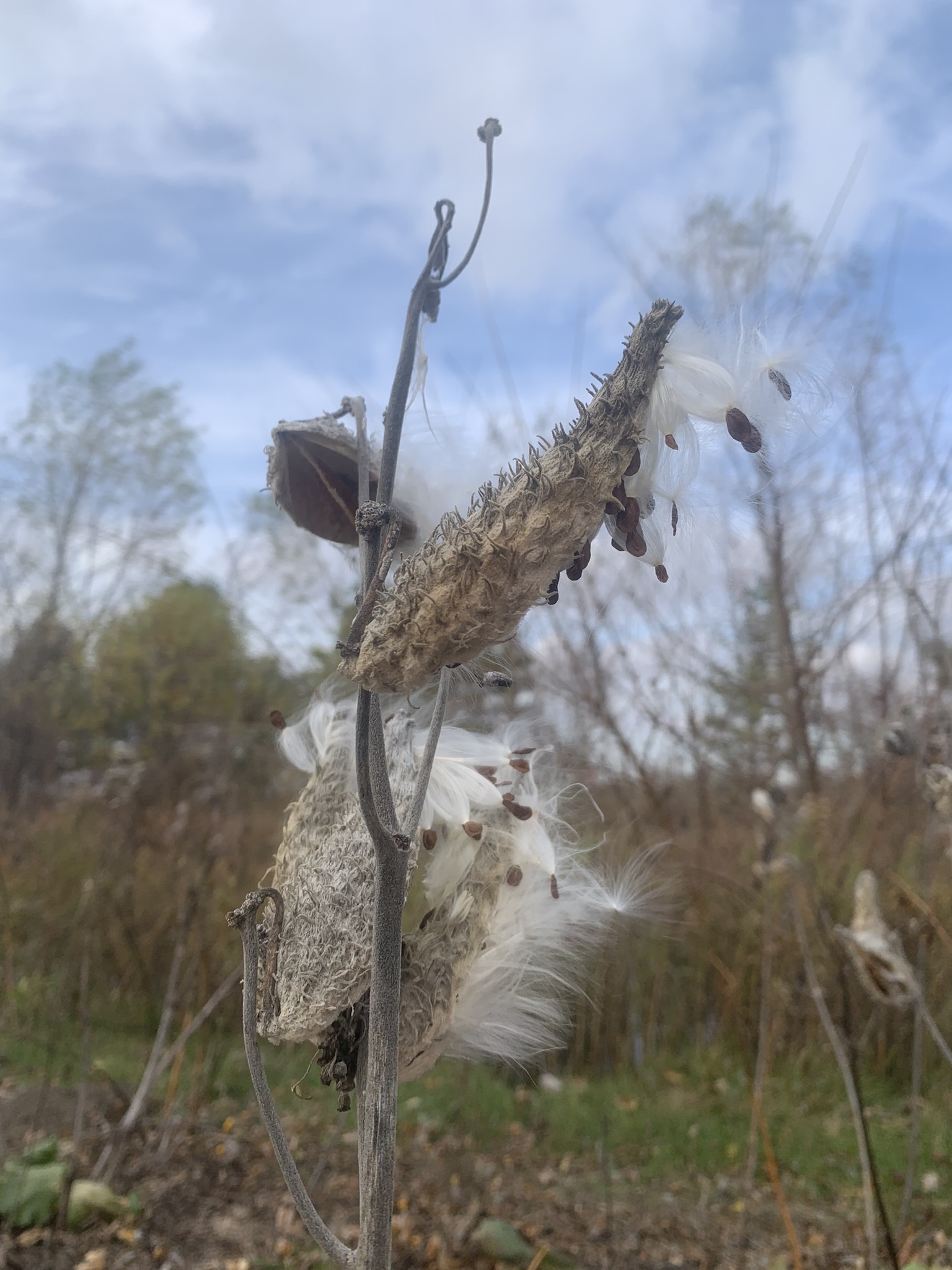
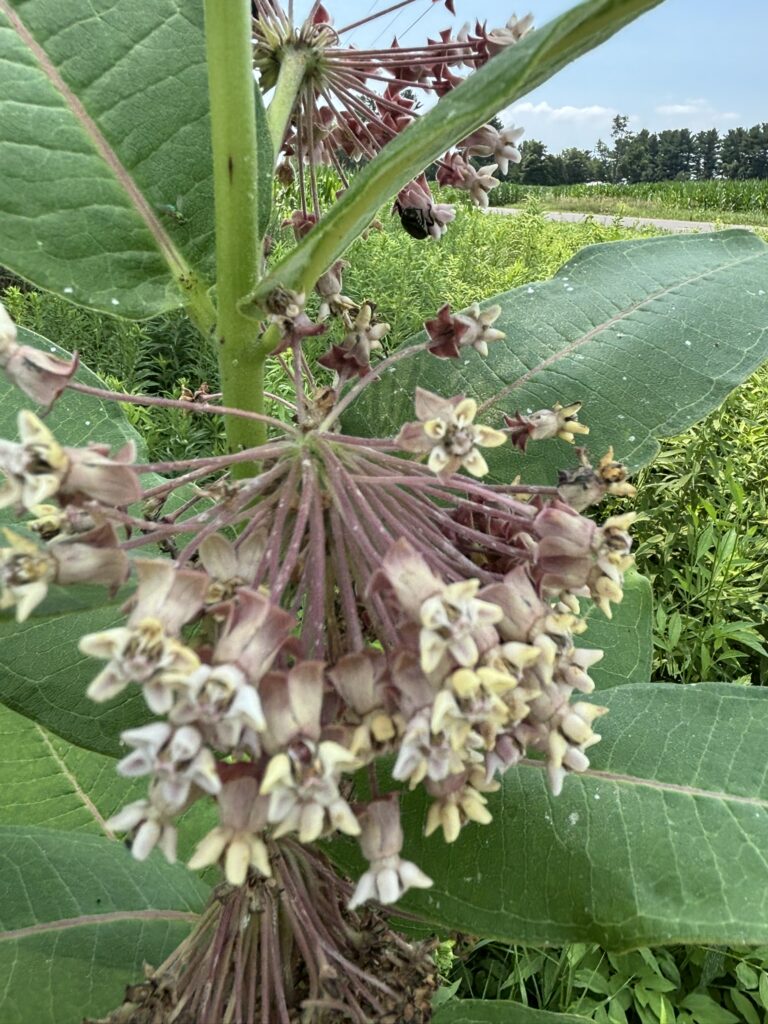
I’ve always loved milkweeds. I remember stands of them along the Glen Elder Reservoir, spilling their fluff out into the endless Kansas wind. I don’t think I ever noticed milkweed flowers until I was a teenager prowling the woods in Ohio, homeschooled and half feral. I followed an incredible sweet, floral scent back to a cluster of pinkish-purple flowers on top of a broad leaf herbaceous plant- Asclepias syriaca, Common Milkweed. This cluster of flowers is called an inflorescence.
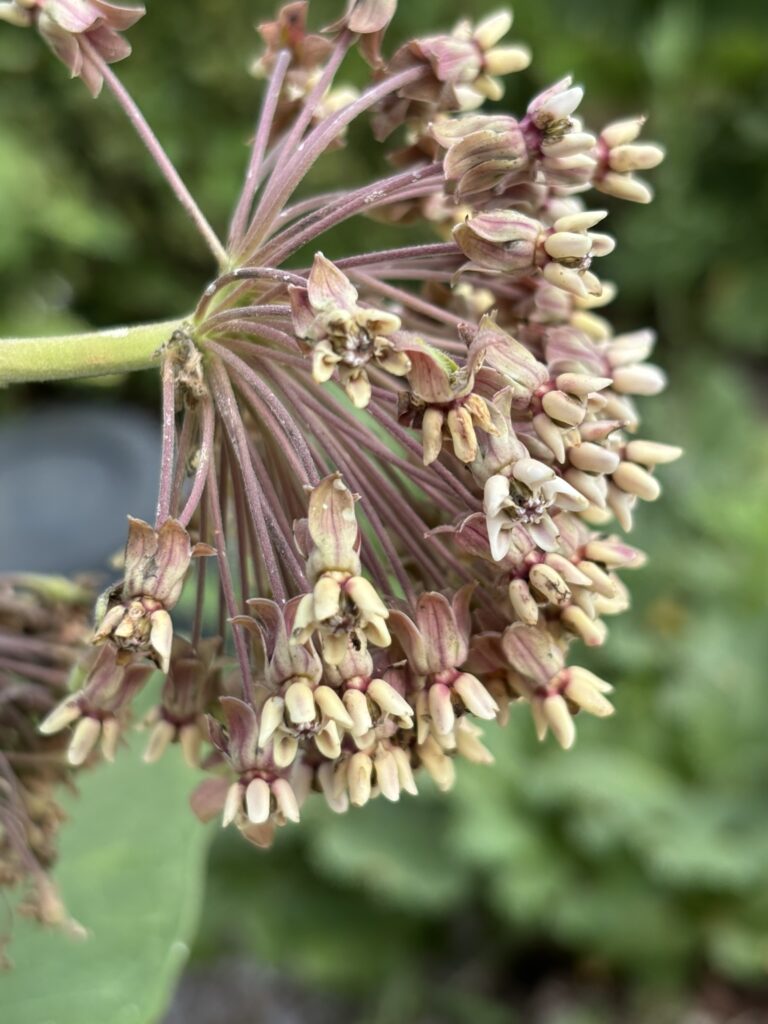
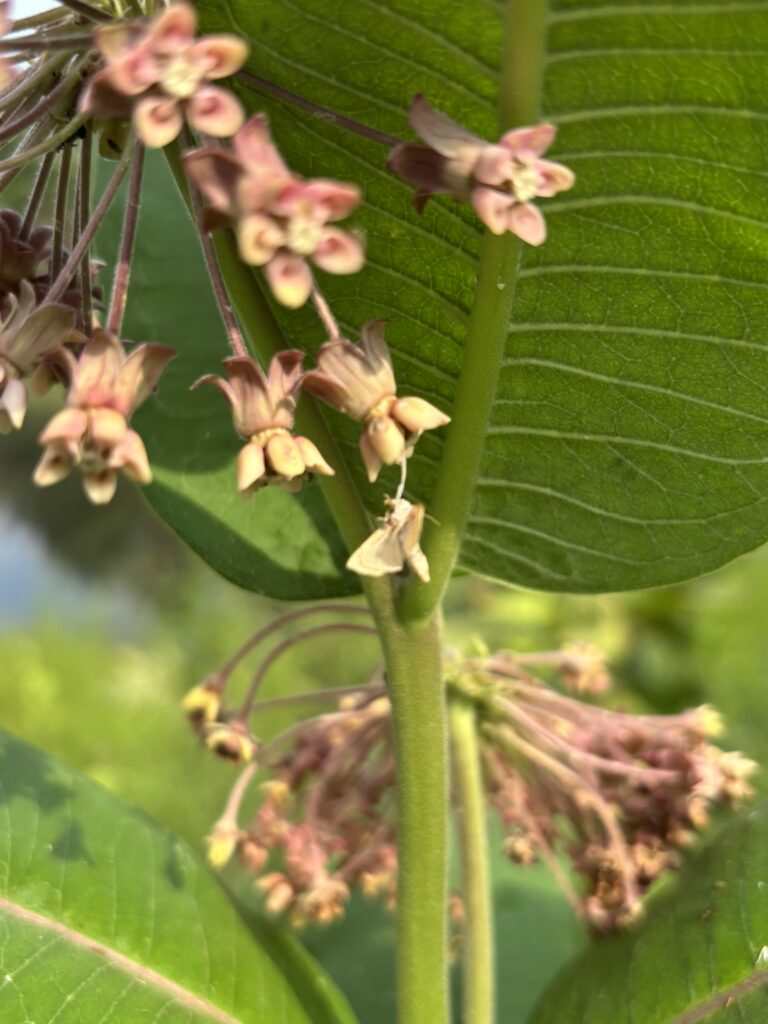
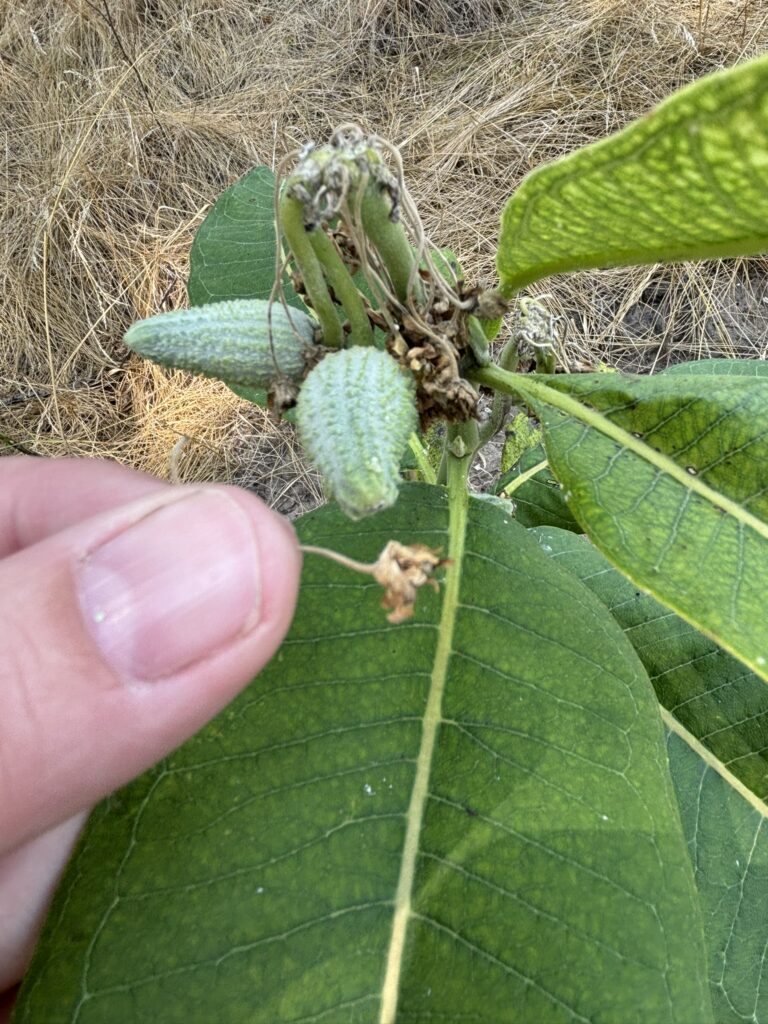
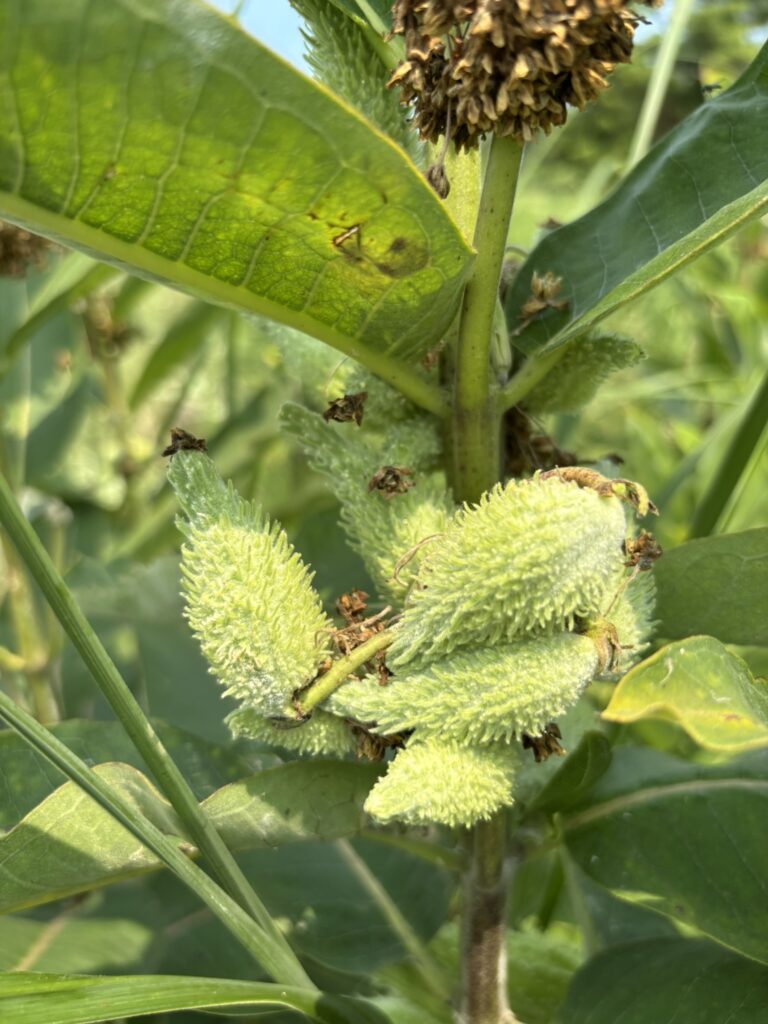
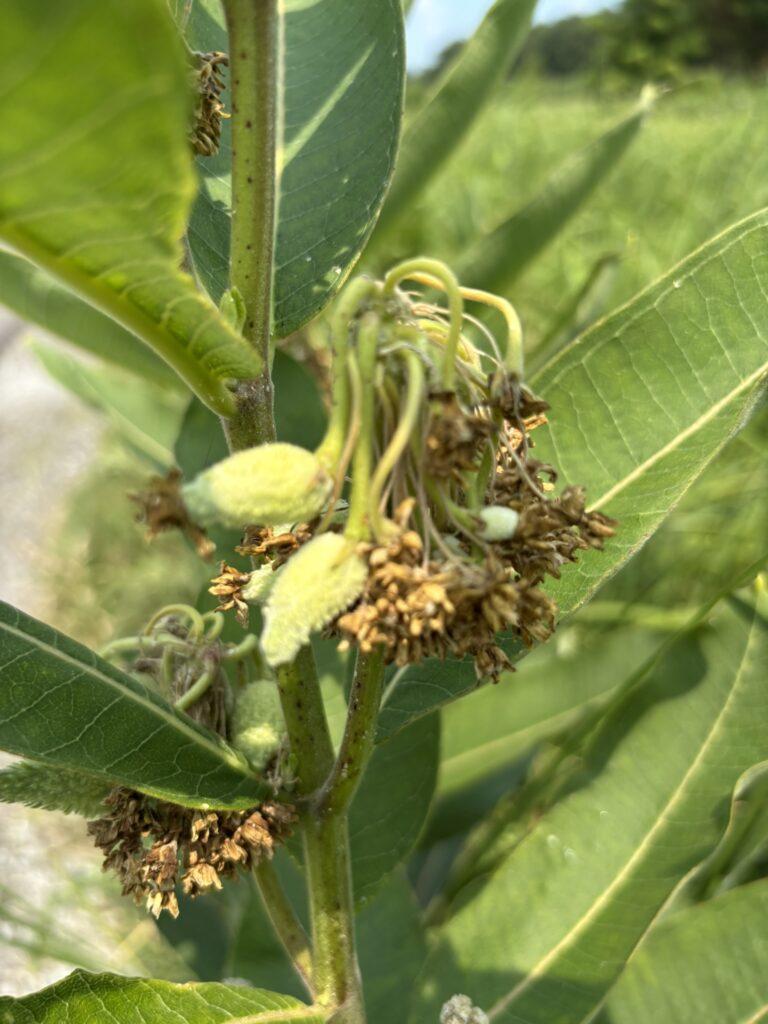
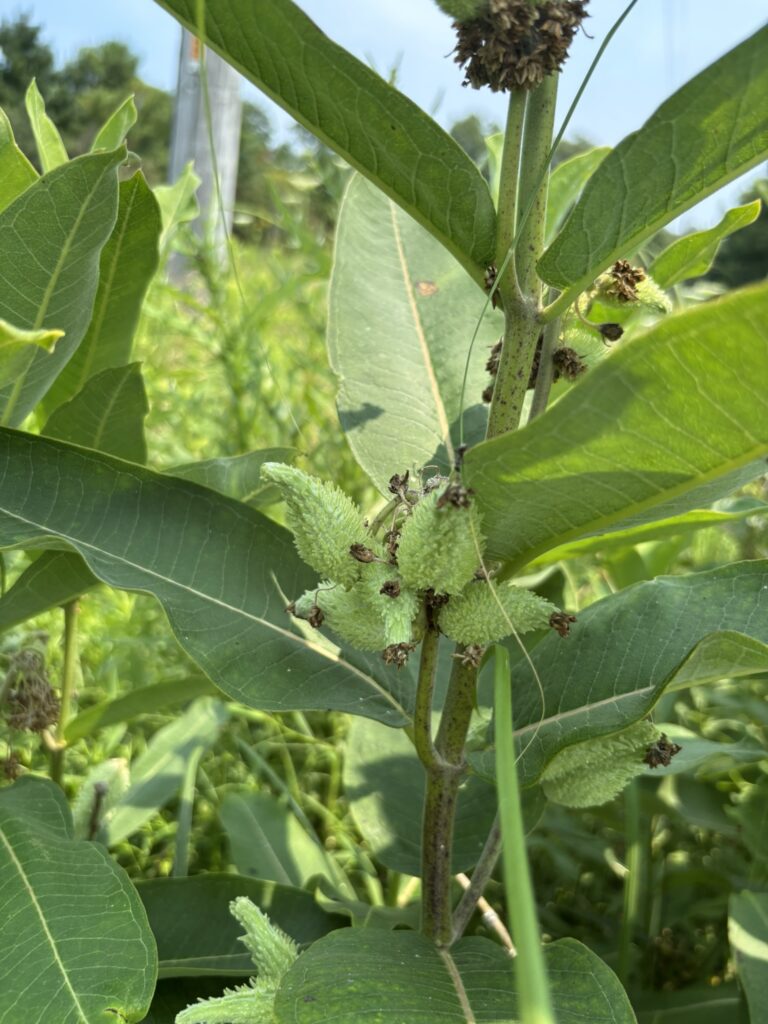
So, through my life I’ve noticed milkweed in fruit and milkweed in flower, but not a milkweed both in fruit and flower- until yesterday. Many of the milkweeds on our long narrow lot are in various stages of fruiting and flower, all in one plant.
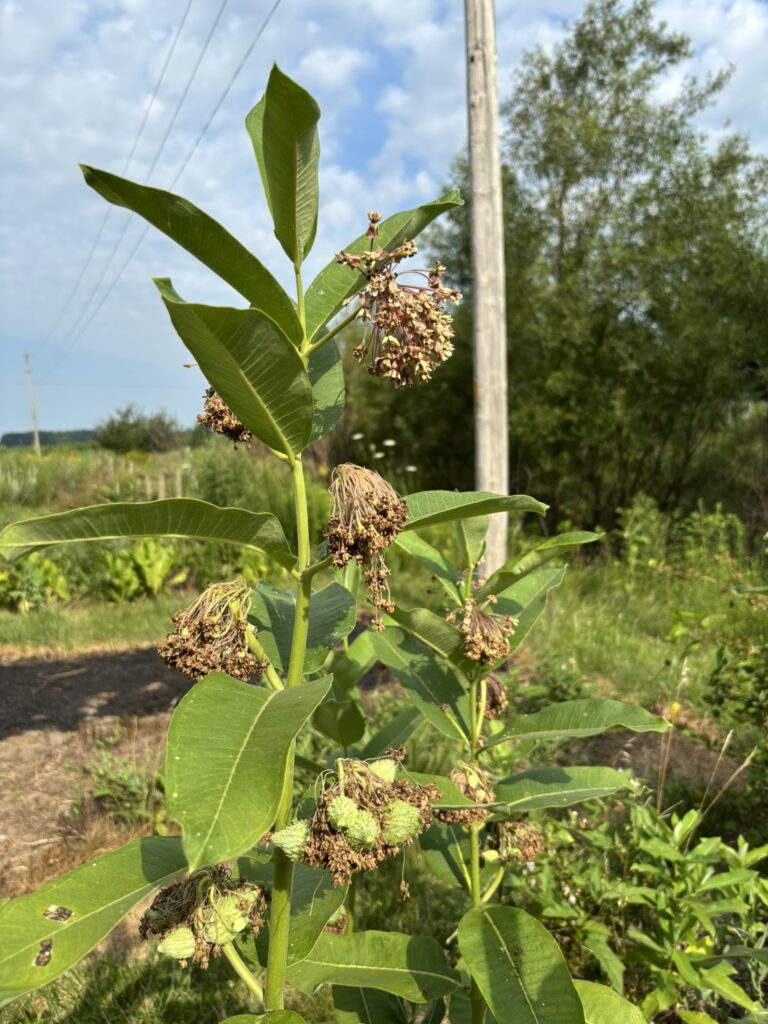
Seeing so many pods from one inflorescence made me wonder how milkweeds are pollinated and how does the plant decide which pods to invest in and allow to develop to maturity and which ones to abort. I know that typically each inflorescence only results in one or two pods. I thought that the plant just chose the first few to allow to develop and the others would never become pods. But here I see eight little pods forming from one flower cluster. So, how does the plant choose?
Love Hurts – Painful Pollination
Milkweed has incredibly complex and derived flowers and a pollination strategy to match. This short video outlines the trap the plant springs to force pollinators to first fly away with a pollinia (a waxy packet of pollen that transfers to other flowers as a single packet) and then uses the same trick to make the insect deposit the pollinia is exactly the right place.
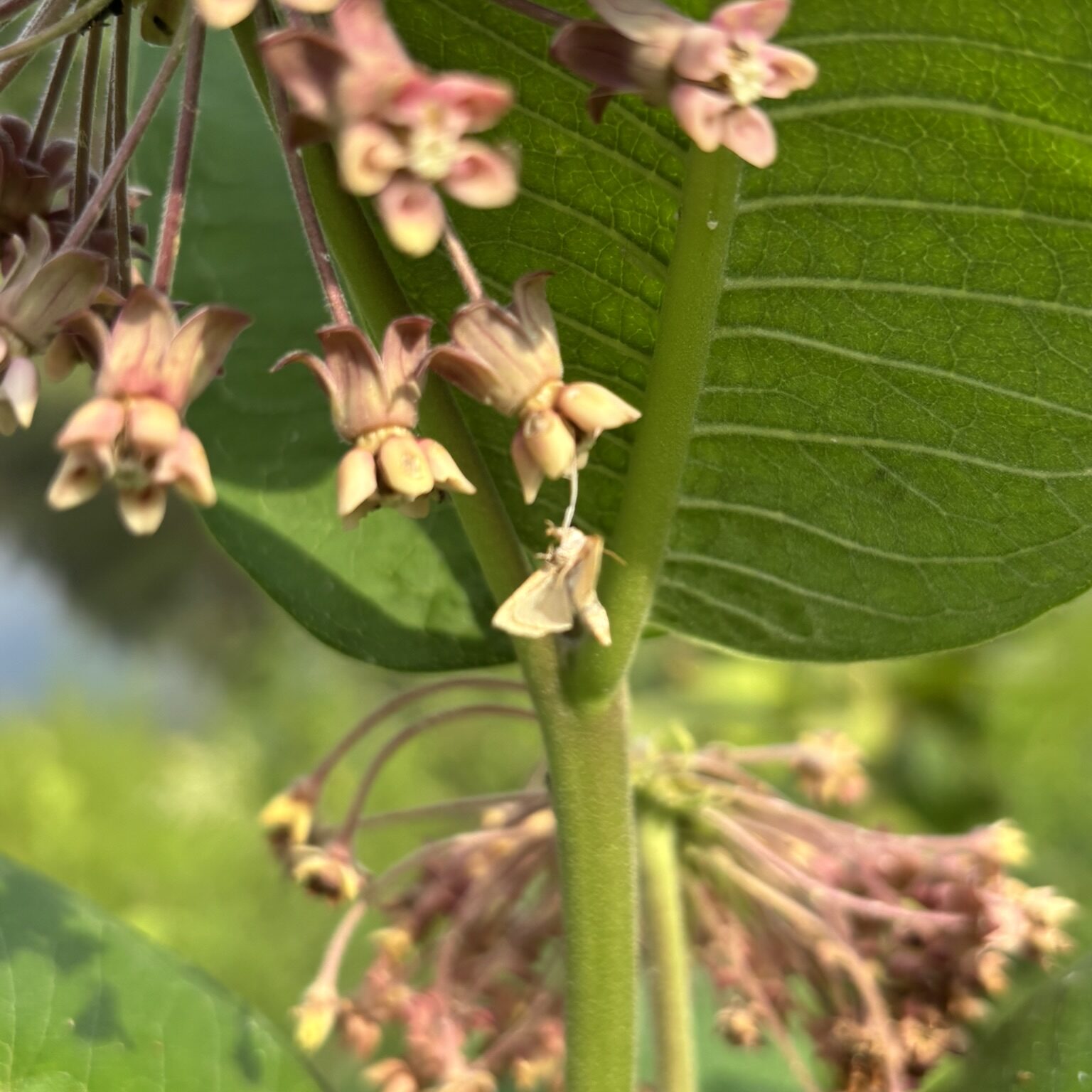
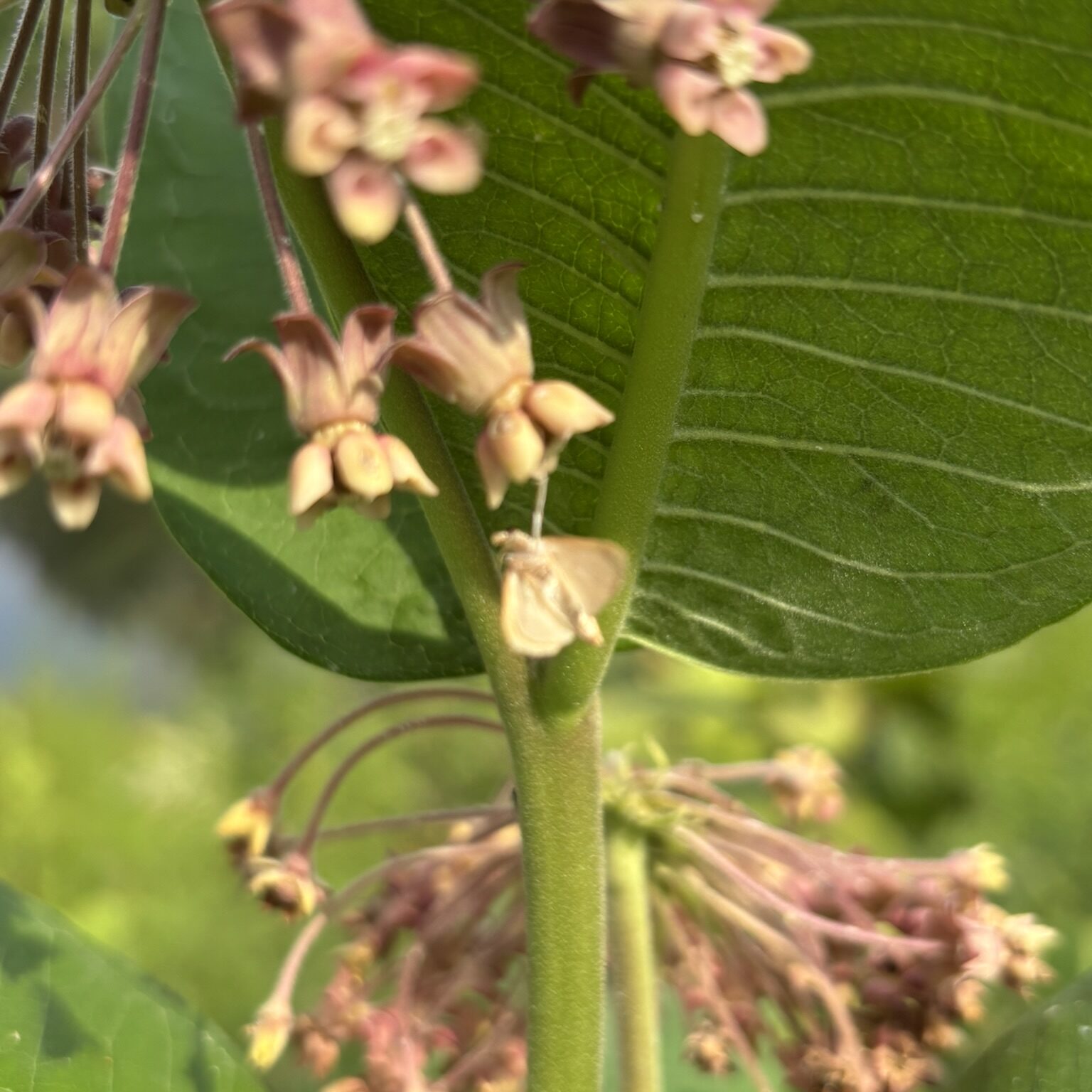
Some insects aren’t large enough to pull their leg through the trap. I saw a little moth dangling by one leg from a milkweed flower today. It perfectly illustrates the fierceness of this pollination strategy. People often think of plants as passive, of flowers as beautiful and sweet. But reality is much more interesting and dangerous.
Ultimately, each flower in an inflorescence has the potential to be pollinated and develop into a milkweed pod, ripe with hundreds of seeds. But that isn’t what happens. Only one or two flowers develop into fully mature pods. Why? How does the plant choose which fertilized flowers will become pods? It can’t be related to amounts of pollination because they’re receiving a packet of pollen, not individual grains.
Plant Choices
Stephenson (1981) reports that “among milkweeds, 95% of the flowers of Asclepias syriaca had a pollinium inserted into at least one of the five stigmatic chambers, but only 9.6% of the flowers set fruit. Only one pollinium is required for fruit set.” So why the discrepancy? How does the plant choose?
It could be timing- all the pods receive the same chemical signals and the ones to respond quickest with their own signals receive additional feedback, mature faster, and ultimately signal for the abscission of the others.
Maybe it’s a race? The first flower to receive pollen is more likely to develop to maturity.
It could be related to insect predation. Pods that have any signs of damage don’t get the signal to mature. It could be to promote outcrossing. Maybe genetic signals that warn the pollen donor is too closely related to the plant shut down development early on in the process.
Maybe it’s a combination of these in conjunction with the plant’s environment?
Choosing Females are Choosy
In her 1982 thesis, “Evolutionary and Ecological Basis for Selective Fruit Maturation in Asclepias” Susan Stone Bookman suggests selective fruit maturation is linked to sexual selection- the plant being choosy about pollen donors. She writes:
“Success of pollen donors in pod production correlated with measurements of pollen germination and vigor in vitro when pollen of one donor was provided per umbel. When three donors per umbel were provided, only two donors produced as many pods as when donors were applied singly indicating a preference by females for certain males. Preferred males fathered pods containing more seeds at a reduced cost per seed and fathered larger seedlings at one month with a higher percentage of emergence.”
So they ran an experiment where pollinia from three different plants were used to pollenate all the flowers in inflorescences. They found that it was more likely for a flower to develop into a mature pod if it was pollinated from specific plant. They went further and found that these pods had more seeds than those pollinated by less vigorous pollen donors and larger seedlings. I wonder if this has been repeated in other species or the molecular basis for this has been studied. Sadly, I can’t read the entire article. I need to explore Indiana’s INSPIRE program to see if I can get access to this and newer references.
Dangerous Pickled Pods?
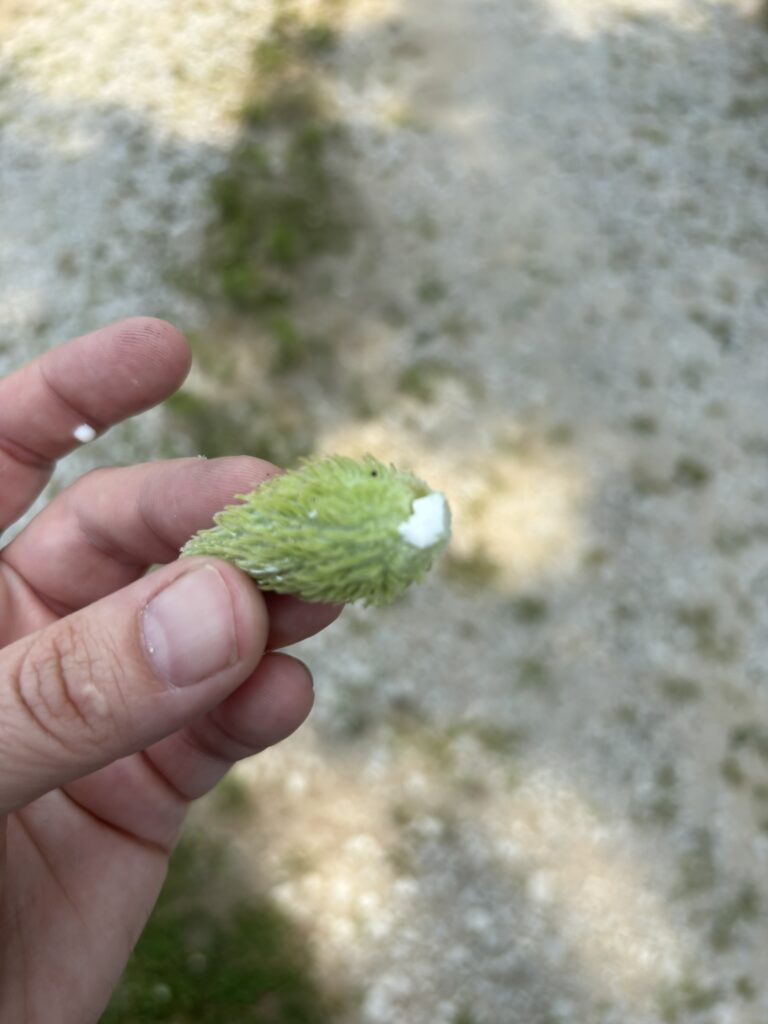
All this reading made me hungry and Stuart just said you can eat common milkweed pods. A bit of google and sure enough- there are many recipes for pickled milkweed pods and even batter dipped and fried pods.
Poison.org reports that all members of the Asclepias genus are toxic, containing cardiac glycosides. But their examples of people calling into the center are people saying they ate some milkweed and then not really reporting any symptoms or having any issues. They reference this 2013 Pub Med Article by Simpson et al. where a man had mild symptoms (perhaps a lower than normal heart rate) and elevated serum digoxin levels after eating five fried pods of milkweed. Another PubMed article outlines the case of a woman who developed heart palpitations and vomiting after sautéing and eating 8-10 pods.
But I couldn’t find any documentation where someone became seriously ill after eating them- no death or long term hospitalization. And I wonder if blanching these a few times would help leach out the digoxin? I bet it would, but I’m also over here thinking… do I want to take that chance? Maybe!

References
Bookman, Susan Stone. “Evolutionary and Ecological Basis for Selective Fruit Maturation in Asclepias.” PhD diss, Washington State University, 1982. ProQuest Dissertations & Theses Global. https://www.proquest.com/openview/5d2f31466487a0c3171fe673b20c8db8/1
Diana Pei and William G. Troutman, “Milkweed Plants Can Cause Serious Poisoning,” Poison Control, https://www.poison.org/articles/milkweed-can-cause-serious-poisoning-204
Shanahan, K. M., Thomas, M. A., Walker, E. N., & Downs, J. W. (2023). Forage and You Shall Find: Cardiac Glycoside Poisoning and the Danger of Foraging. Military medicine, 188(7-8), e2812–e2815. https://doi.org/10.1093/milmed/usac287
Simpson, N. S., Cole, J. B., & Ellsworth, H. (2013). What toxicity may result from ingestion of the plant pictured below? Answer: cardioactive steroid toxicity from common milkweed. Journal of medical toxicology : official journal of the American College of Medical Toxicology, 9(3), 287–288. https://doi.org/10.1007/s13181-013-0322-y
Stephenson, A. G. “Flower and Fruit Abortion: Proximate Causes and Ultimate Functions.” Annual Review of Ecology and Systematics 12 (1981): 253–79. http://www.jstor.org/stable/2097112.